
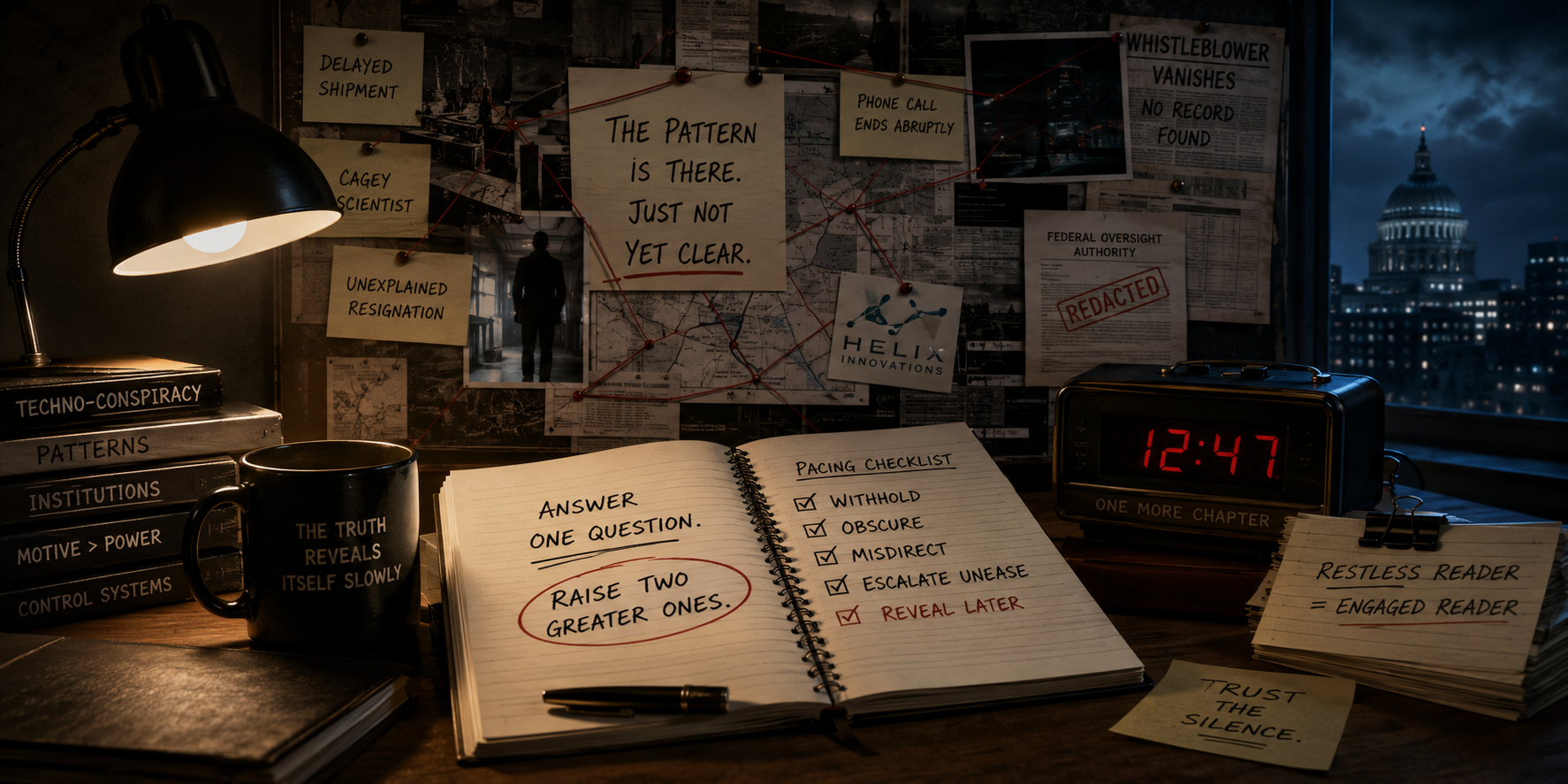
Every techno-conspiracy thriller writer chases the same elusive feeling: a reader who cannot put the book down yet cannot quite explain why. That feeling rarely comes from a single explosive scene or a dramatic reveal on page one. Instead, it builds slowly, chapter after chapter, when you pace the paranoia, until the pressure becomes almost unbearable and the reader starts reading well past their own bedtime. Mastering that build, rather than chasing constant spectacle, is the real craft behind slow-burn tension, and it is what separates memorable conspiracy fiction from forgettable airport paperbacks that fade from memory within a week of finishing them. This post breaks down exactly how that build works, and how any writer can start applying it in their next draft.
Consider how The Terminal Gene layers its early chapters to demonstrate this principle in practice. Rather than revealing Helix Innovations’ full agenda in chapter one, the story doles out fragments across dozens of pages: a delayed shipment, a cagey scientist, an unexplained resignation, a phone call that ends too abruptly. Consequently, readers assemble the conspiracy themselves, one clue at a time, long before Dr. Emily Harper fully connects the pieces herself. That slow accumulation, not a single dramatic twist, is ultimately what keeps the pages turning well past midnight, and it rewards attentive readers who notice details the protagonist has not yet pieced together.
Slow-Burn Tension in Thriller Writing
Slow-burn tension in thriller writing depends almost entirely on restraint, which is often harder to practice than it sounds, especially for writers eager to show off a clever twist. Writers must resist the urge to explain too soon, because clarity kills curiosity before it has a chance to build into genuine dread.
Instead, each chapter should answer one small question while quietly raising two larger ones in its place, so the plot always feels like it is expanding rather than resolving. As a result, the reader’s need to know consistently outpaces the story’s willingness to tell, and that widening gap is exactly where lasting tension lives. Consequently, disciplined writers often cut their favorite explanatory paragraph entirely during revision, trusting the reader to keep reading anyway.
Structure carries much of this weight, often more than dialogue or action ever could, particularly across a full-length novel rather than a single scene. Varying the pace between high-intensity sequences and quieter moments keeps readers engaged while preventing the story from becoming exhausting or predictable. Alternating between calm, ordinary scenes and moments of quiet unease trains readers to distrust stillness itself, which is a powerful and frequently underused tool in this genre.
Pacing Techniques and Reader Psychology in Suspense
Pacing techniques for suspense fiction work precisely because of reader psychology and suspense; humans are wired, almost instinctively, to fill silence with worst-case scenarios rather than neutral ones. Therefore, an unanswered question often feels more dangerous to a reader than any answer could ever actually turn out to be.
Short chapters that end mid-scene, rather than at a natural resting point, exploit this instinct particularly effectively, and they also encourage the compulsive one-more-chapter reading habit publishers love. Similarly, withholding a character’s true motive for several chapters forces readers to project their own fears onto that character, which deepens engagement without requiring a single new plot event to occur. Ultimately, the reader’s own imagination becomes the most effective co-writer any thriller can have.
Slow-burn tension ultimately rewards patience, both the writer’s and the reader’s, and few genuine shortcuts exist around that simple truth. By withholding explanation a little longer than feels comfortable, alternating calm with unease, and trusting proven pacing techniques for suspense fiction to do the heavy lifting, a techno-conspiracy thriller can hold a reader long after the lights go out and the house has gone quiet. Ultimately, restraint on the page becomes momentum in the reader’s mind. Start your next chapter by cutting one explanation you were tempted to give away too early, and watch the tension do the rest of the work for you.